
Header bidding vs Open Bidding vs the waterfall: how each auction works in 2026
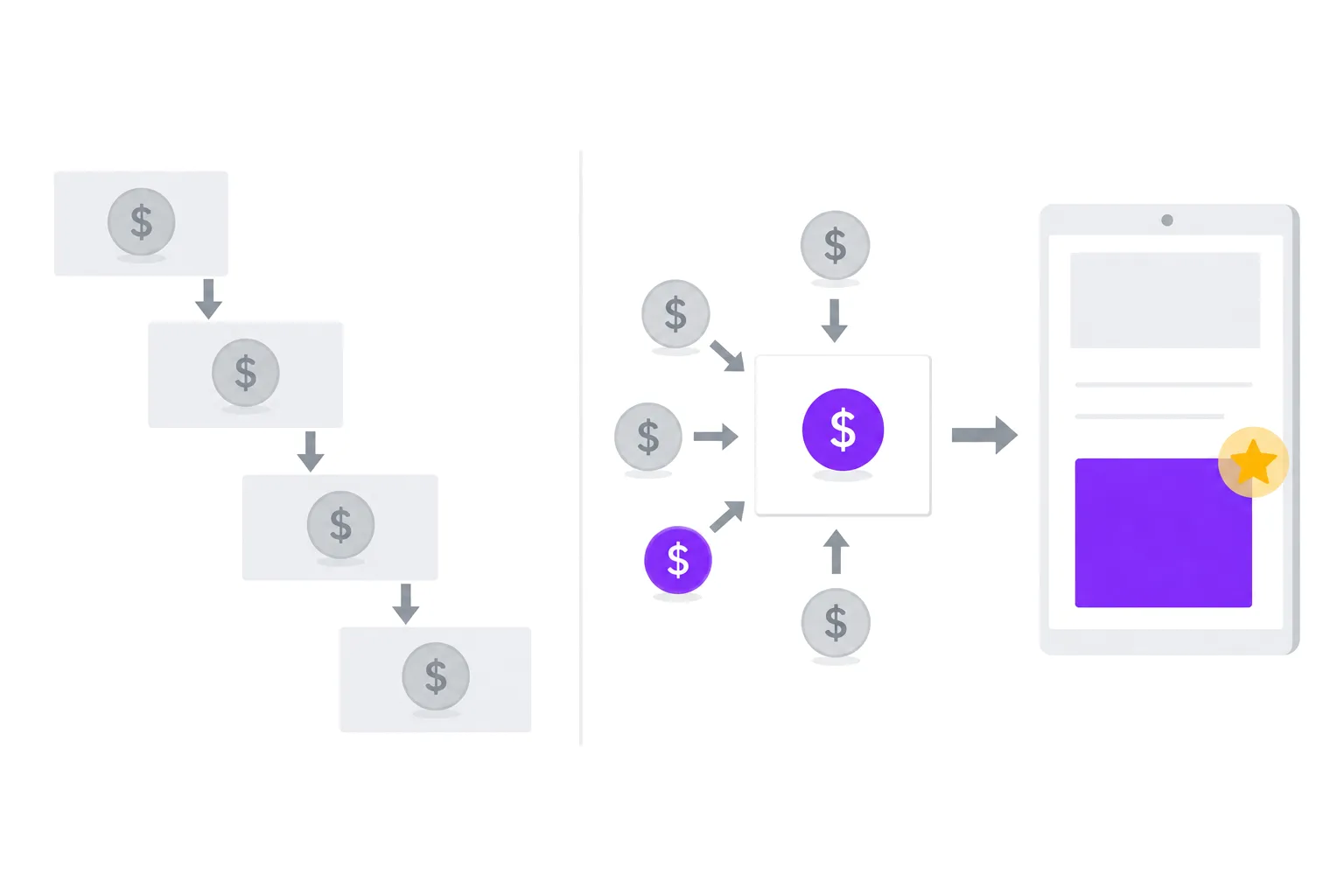
There are three ways demand can reach an ad slot on a site that uses Google Ad Manager: a waterfall of line items, a header bidding auction that runs before the ad server, and Google's Open Bidding, which runs inside the ad server. Most publishers of any size run the second and third together. Here is how each one works, what it costs you, and what changes after the 2026 US court remedies against Google.
The waterfall
In a waterfall, the ad server calls demand sources one after another in a fixed order. Each source gets the impression at a set price: if the first one wants it, it takes it; if not, the request falls to the next one, and so on down the list.
The order is set by historical average CPMs, not by what each buyer would pay for this impression. So a buyer lower in the list who would have paid more for this particular reader never gets asked. Every pass down the waterfall also adds a round trip, which makes lower tiers slower and more likely to time out.
Waterfalls still exist in a few places: app mediation, some direct-sold setups, and as the fallback line items that sit behind an auction. As the main way to sell open market inventory on the web, they have been replaced.
Header bidding
Header bidding runs an auction in the page, or on a server acting for the page, before the ad server is called. Prebid.js, the open-source library behind most header bidding on the web, sends bid requests to all configured demand partners at once, waits up to a timeout, and passes the bids to Google Ad Manager as key-values. In GAM, those bids compete through line items (or through Google's header bidding trafficking, on Ad Manager 360) against AdX, Open Bidding and direct campaigns.
What it fixes: every partner bids on every impression at the same time, so the price reflects what buyers will actually pay for this reader on this page, not their average last month.
What it costs:
- Latency. The ad server waits for the auction. A 2019 study of about 35,000 sites, No More Chasing Waterfalls, found header bidding latency up to three times that of waterfall setups in the median case. How long the auction takes depends heavily on the timeout, the number of bidders and how much runs server-side; see our guide to setting a Prebid timeout.
- Page weight and requests. Each client-side bidder adds network requests and often user sync iframes. That is why too many bidders can cost you money.
- Operations. Line items, price buckets, bidder configuration, consent handling, ads.txt and Prebid upgrades all need maintaining. That is the work a managed wrapper like Valuad's takes on.
Prebid Server moves part of the auction to a server: the page sends one request, and the server calls the bidders. Most mature setups run a hybrid of client-side and server-side bidders.
Open Bidding
Open Bidding is Google's own server-side auction inside Google Ad Manager. Third-party exchanges and SSPs that are Open Bidding partners bid directly in Ad Manager's auction, alongside AdX, without any code on your page. You set it up in GAM yield groups.
What it offers: no page latency for those partners, and billing and payment consolidated through Google.
What it costs:
- A fee to Google on Open Bidding revenue, on top of the exchange's own margin.
- Visibility. The auction runs inside Google's systems. You see results in GAM reports, but not the bid landscape in the detail Prebid analytics can give you.
- Partner coverage. Only exchanges that have joined Open Bidding can take part, and the list is not the same as the Prebid adapter list.
Which one wins an impression
On a typical site, all three meet in Google Ad Manager's auction. Prebid bids arrive as key-values and compete through line items or header bidding trafficking. Open Bidding and AdX bid in the ad server's own auction. Direct campaigns compete by priority and price. GAM has run a first-price auction since 2019, so the highest net price wins and pays what it bid.
The main structural complaint about this arrangement was that Google's own demand saw more than everyone else: first look, last look, and floors that had to be the same for everyone. That is what has just changed.
What changes after the 2026 remedies
In September 2026 the court in the US ad tech case decided behavioral remedies instead of a breakup. As reported by AdExchanger, they include API integrations connecting AdX and DFP with Prebid, AdX bidding into rival ad servers on the same terms as into DFP, an end to first look and last look, per-bidder floors, and win and loss bid data for publishers. The final judgment is due October 2, 2026, so the details may still move.
Google had already ended Unified Pricing Rules in December 2025, and per-bidder floors are available in Ad Manager today.
For publishers, the direction is clear even before the details are final: Prebid demand and Google demand are going to compete on more equal terms, with more data, and that makes a well-run header bidding setup worth more. We cover the specifics in what the Google remedies change for Prebid publishers.
Which should you run?
For a publisher on Google Ad Manager with a few million page views a month or more, the practical answer is header bidding plus AdX, with Open Bidding for partners that are only available there or that you prefer to pay through Google. The questions worth spending time on are which partners run client-side, which server-side and which through Open Bidding, and whether each one earns more than it costs in latency and requests. Those answers come from your own data, per partner, and they change as partners and pages change.
Want a second pair of eyes on your setup? Talk to the Valuad AdOps team.